Argo Blockchain uses mining hardware and power infrastructure to earn cryptocurrency through mining pools
Argo Blockchain plc is a cryptocurrency mining company that contributes computing work to mining pools using specialized equipment. The business centers on Bitcoin, with physical mining operations in North America. A restructuring completed in December 2025 changed its financing and ownership. Power infrastructure supports the machines, while pool contracts govern compensation for their computing work. Zcash mining has also formed part of its activities. Artificial intelligence and high-performance computing remained under evaluation in September 2026.
Mining payments and interrupted machine deployment
Powered machines normally contribute computational work to a mining pool, which coordinates the search for valid Bitcoin blocks. The pool compensates that work under its payout agreement. Equipment, electricity and the pool arrangement perform different jobs within the same revenue process.
Hashrate measures how quickly hardware performs these calculations. Purpose-built chips repeatedly test candidate block headers against Bitcoin's proof-of-work target. A higher rated hashrate describes more potential computation; productive output also needs powered, functioning machines.
During 2025, its full pay per share (FPPS) arrangement linked compensation to contributed hashrate, expected block subsidies and transaction fees, less a pool discount. Entitlement applied even when the pool added no block during the contract period. Payment entitlement does not assure receipt: service failures or a shortfall in the pool operator's holdings can prevent distribution.
Refurbishment and relocation interrupted production in early 2025. Across the first half of that year, the company mined 65 Bitcoin, compared with 442 in the first half of 2024. Resuming mining after a move requires serviceable hardware and an energized site. Equipment ownership alone does not establish that machines are earning payments.
During 2023-2025, the company sold mined Bitcoin weekly to fund operating expenses and working capital. Cryptocurrency production therefore supported operating funding alongside external financing.
Power capacity and deployed machines describe different resources
Mining machines and electrical infrastructure have different capacities: megawatts measure power, while exahashes per second measure Bitcoin computing speed. The owned Baie-Comeau facility in Quebec had 15 MW of hydroelectric power capacity in 2025. The restructuring also added mining equipment and infrastructure at leased sites in Alabama, plus electrical assets for future deployment. Hosting agreements with Merkle Standard ended in March and April 2026, changing the fleet's deployment context. Acquired infrastructure and maximum rated hashing speed cannot establish how much equipment is operating on a particular date.
How does electricity affect Argo's mining profitability?
Electricity affects mining profitability through the price of power and the energy needed to operate and cool equipment. Fleets with similar hashing capacity can incur different electricity bills when their machines use different amounts of energy per calculation. Contracted power prices and hosting charges affect direct mining costs. Hardware that earns cryptocurrency can remain uneconomic when those costs exceed the value of its payments. Renewable electricity describes the power source; it does not establish a low tariff or profitable operation.
Bitcoin's market value determines the cash value of the cryptocurrency earned. Network difficulty influences expected output from a given amount of computing work.
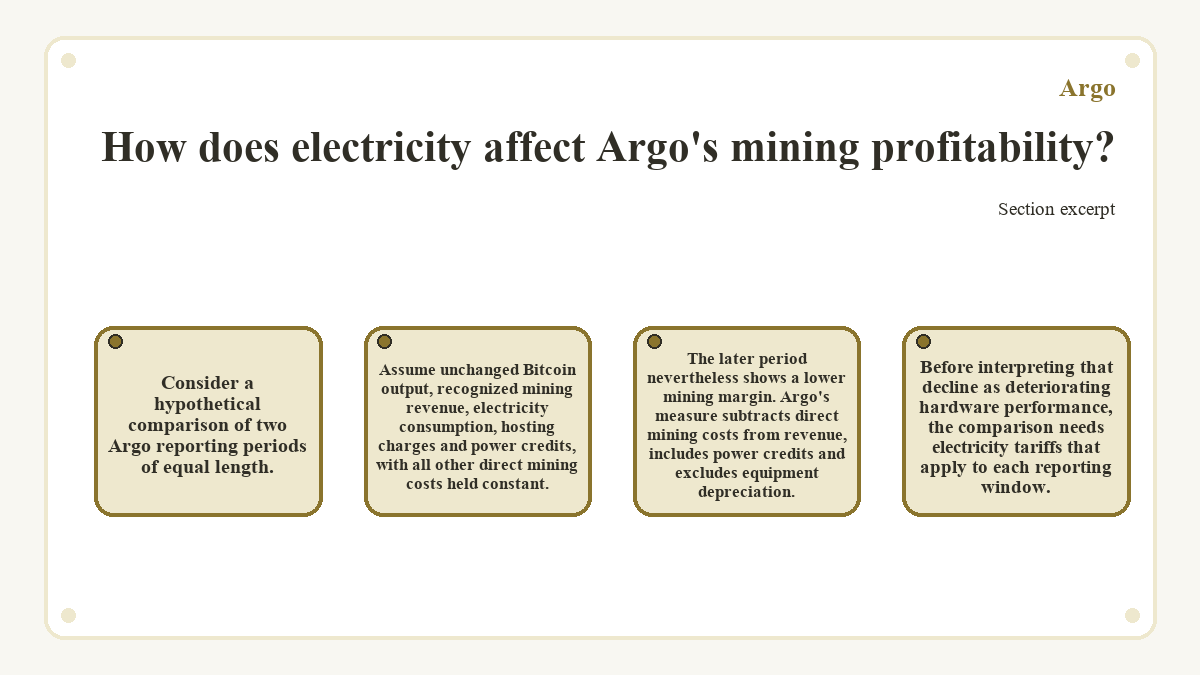
Consider a hypothetical comparison of two Argo reporting periods of equal length. Assume unchanged Bitcoin output, recognized mining revenue, electricity consumption, hosting charges and power credits, with all other direct mining costs held constant. The later period nevertheless shows a lower mining margin. Argo's measure subtracts direct mining costs from revenue, includes power credits and excludes equipment depreciation. Before interpreting that decline as deteriorating hardware performance, the comparison needs electricity tariffs that apply to each reporting window.
Suppose the later period's tariff is higher. With consumption unchanged, electricity expense rises and mining margin falls. The difference is cost per unit of purchased energy, while output remains unchanged. Matching the tariff's effective dates to the operating period establishes whether that cost change belongs in the comparison.
If the tariff is unchanged too, these inputs cannot produce a lower mining margin. The comparison then contains a mismatch in the reporting figures or their accounting basis.
What did the December 2025 restructuring change?
The December 2025 restructuring exchanged debt claims for equity and brought Growler Mining Tuscaloosa LLC into control of the company. Growler contributed mining assets and fresh capital, alongside releasing its loan claims. Issuing shares to meet creditor claims also changed the ownership proportions of existing shareholders.
Argo's December 2025 restructuring cancelled US$40 million of senior notes due in 2026. Shares replaced the cancelled bond obligations. A mortgage remained on the Baie-Comeau property at completion. The asset contribution and cash funding served different purposes: equipment can support productive capacity, while cash supports liquidity and operating expenses. Neither contribution establishes future earnings, because powered deployment, network conditions and electricity charges continue to affect the mining business.
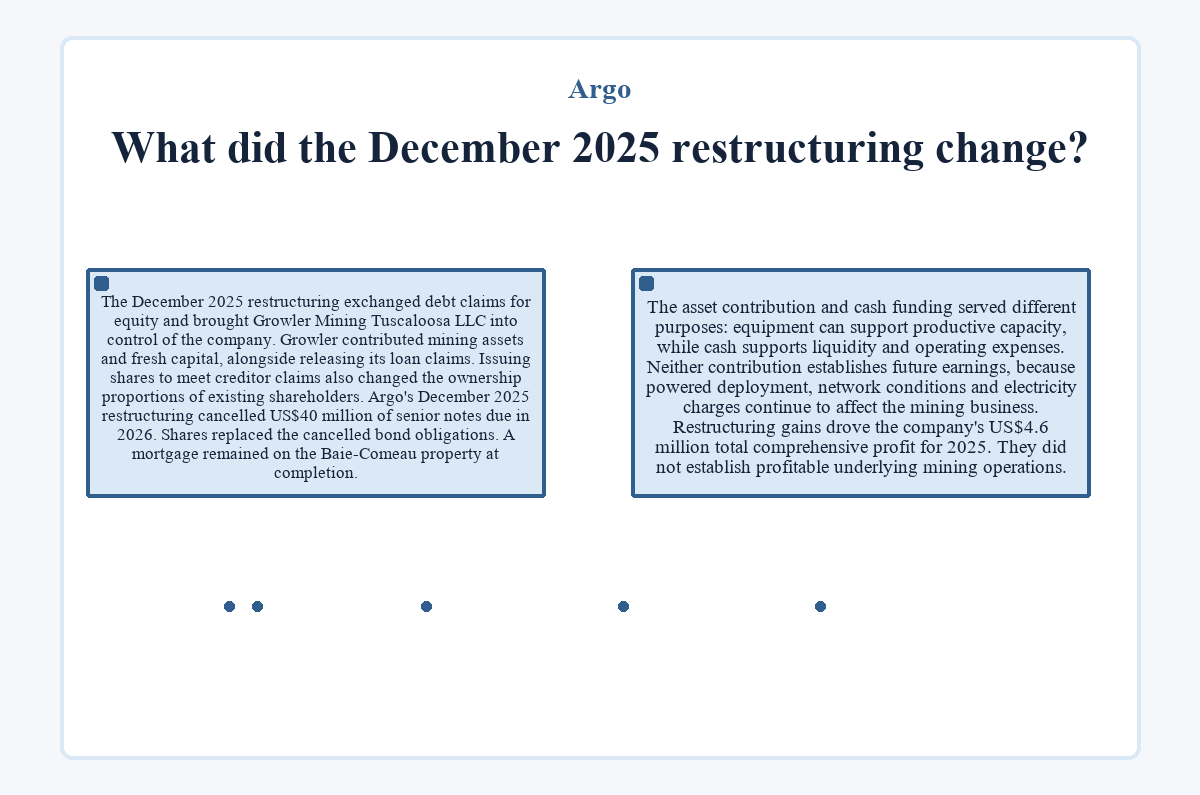
Restructuring gains drove the company's US$4.6 million total comprehensive profit for 2025. They did not establish profitable underlying mining operations.
Share ownership and mined Bitcoin create different exposure
Company securities create exposure to assets, liabilities and management decisions, while holding Bitcoin directly creates exposure to the cryptocurrency itself. Argo's American Depositary Shares trade on Nasdaq under ARBK and represent interests in ordinary shares through a depositary arrangement. Its London Stock Exchange listing ended in December 2025. Corporate securities add operating costs, financing changes and ownership dilution to Bitcoin-related risk. Shareholders do not receive a personal allocation of coins whenever the company's mining equipment earns a payment. The company's treasury decisions determine how its cryptocurrency holdings are used.
Zcash mining and proposed computing expansion
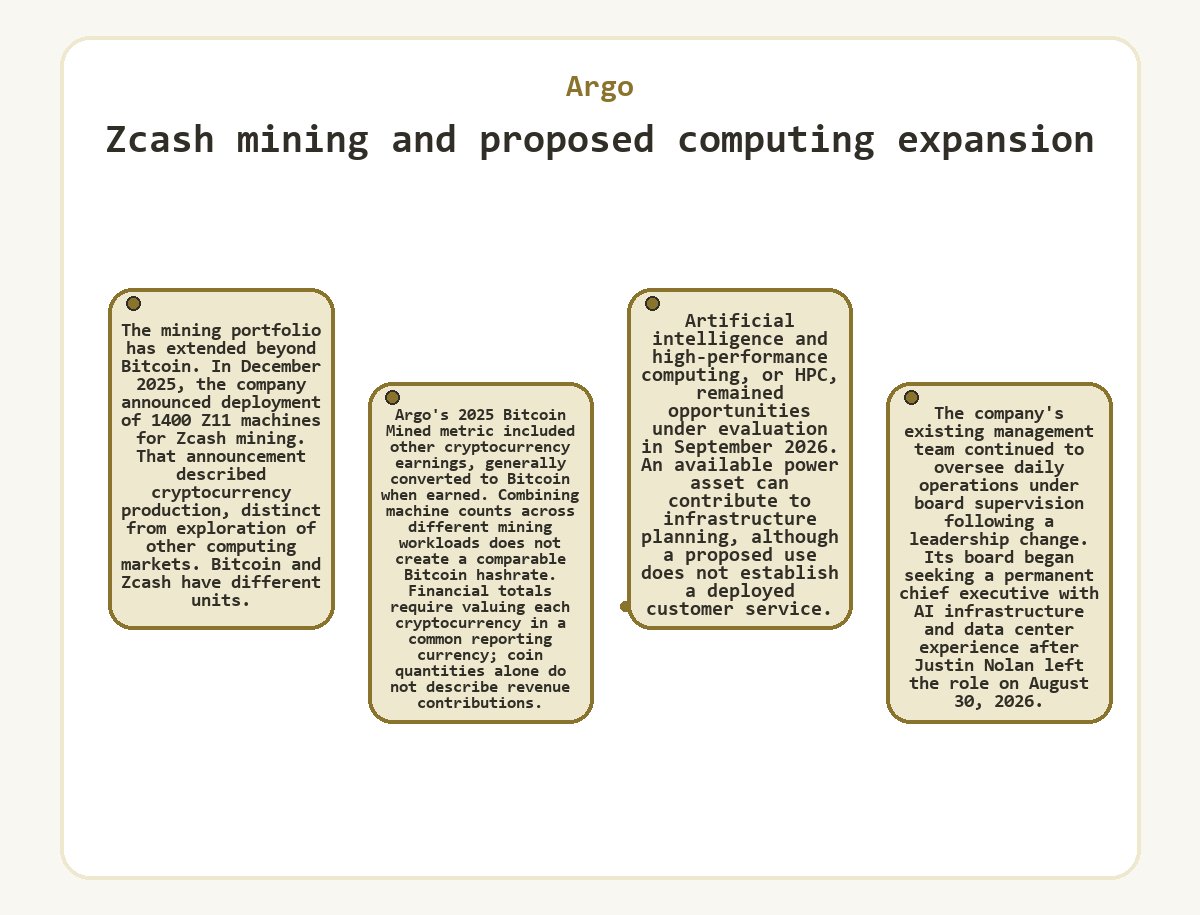
The mining portfolio has extended beyond Bitcoin. In December 2025, the company announced deployment of 1400 Z11 machines for Zcash mining. That announcement described cryptocurrency production, distinct from exploration of other computing markets. Bitcoin and Zcash have different units. Argo's 2025 Bitcoin Mined metric included other cryptocurrency earnings, generally converted to Bitcoin when earned. Combining machine counts across different mining workloads does not create a comparable Bitcoin hashrate. Financial totals require valuing each cryptocurrency in a common reporting currency; coin quantities alone do not describe revenue contributions.
Artificial intelligence and high-performance computing, or HPC, remained opportunities under evaluation in September 2026. An available power asset can contribute to infrastructure planning, although a proposed use does not establish a deployed customer service. The company's existing management team continued to oversee daily operations under board supervision following a leadership change. Its board began seeking a permanent chief executive with AI infrastructure and data center experience after Justin Nolan left the role on August 30, 2026.
Argo: reader questions
Can I join a retail mining program run by Argo?
Argo does not offer retail mining applications or programs. An app that requests deposits under its name is inconsistent with that policy. The company also states that it will not ask individuals to send money. Corporate branding alone does not establish that a purported mining account is genuine.
Does one ARBK depositary share equal one ordinary share?
An ARBK American Depositary Share represented 2160 ordinary shares under the ratio implemented on December 12, 2025. The depositary unit and underlying ordinary share therefore use different scales. Share-count and earnings-per-share comparisons need the applicable ratio and reporting period. Changing that ratio does not by itself create productive assets or improve mining income.
Which costs are excluded from Argo's mining margin?
Argo's mining margin excludes mining equipment depreciation and is distinct from overall profit. Its 2025 interim calculation deducted power and hosting costs from revenue and included applicable power credits. Depreciation then reduced gross profit. Administrative expenses and financing costs affected other income-statement lines, so a positive mining margin could coexist with a net loss.
Can the Z11 machines used for Zcash also mine Bitcoin?
The Z11 hardware announced for Zcash mining is designed for Equihash, not Bitcoin's SHA-256 mining algorithm. Algorithm-specific mining chips are not interchangeable across these workloads. Zcash computing performance cannot be added directly to the Bitcoin fleet's hashrate, because the equipment performs a different type of computational work.
How does a Bitcoin halving affect Argo's pool income?
A Bitcoin halving reduces the subsidy available per block, which is one input in the FPPS compensation model that Argo used in 2025. Bitcoin's block subsidy halves every 210,000 blocks. Transaction fees remain distinct from that subsidy. The overall payment also depends on contributed computing work and network difficulty, while Bitcoin's market value affects the cash value of the cryptocurrency earned.